Here's a question we get almost every single day: "What size should I go for?"
And honestly? It's the right question to ask. Because size is the one thing people get wrong more than anything else — more than framing, more than finish, more than which photo to even print. You can have the most beautiful image in the world, but if it's the wrong size for the wall, it just... sits there. Looking a bit lost.
So let's fix that.
I'm going to walk you through how we actually think about sizing when clients come to us — whether it's a single photo for a bedroom in Jumeirah or a five-panel split canvas for a hotel lobby in Downtown Dubai. Same logic applies either way.
The mistake almost everyone makes
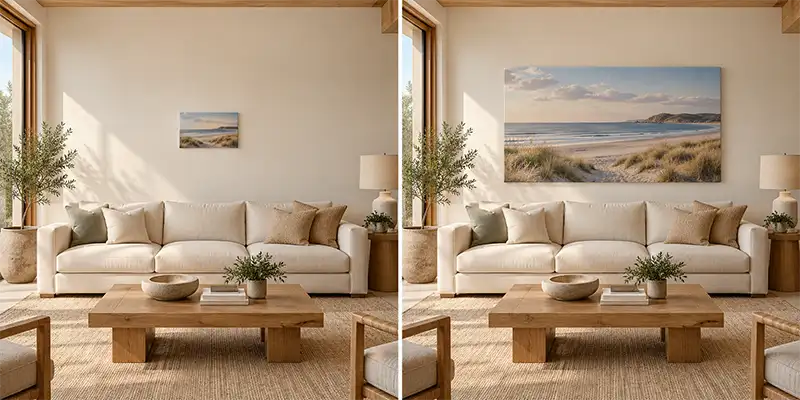
People size their canvas to the photo. Not the wall.
That's backwards.
A photo can be cropped, stretched, split across panels, reprinted in a dozen ratios — it's flexible. Your wall isn't. It's a fixed space with a fixed amount of visual weight it needs filled. So the wall should decide the size, and the image should be made to fit it, not the other way around.
I know that sounds obvious once you say it out loud. But most people order a canvas the way they'd order a printed photo for an album — pick a size that "feels about right," get it delivered, hang it up... and then it looks smaller than they imagined. Almost every time.
Start with the wall, not the inches
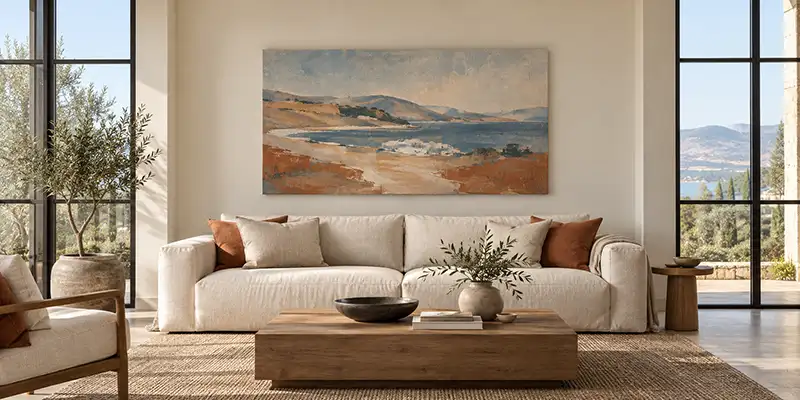
Before you even think about 24x36 vs 40x60, go stand in front of the actual wall. Seriously — walk over there right now if you can.
A few things to check:
- How much empty wall space do you actually have? Not the whole wall — the space above furniture, between windows, or in that awkward hallway stretch.
- How far away will people usually be standing or sitting when they look at it? A living room sofa view is different from a hallway you just walk past.
- Is there other art or decor nearby competing for attention?
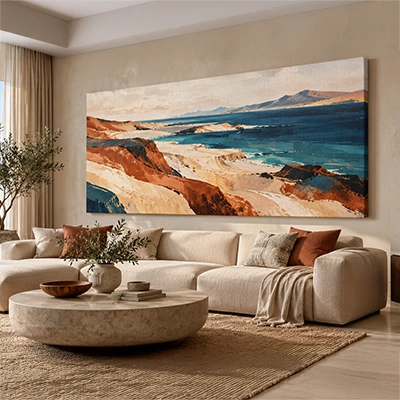
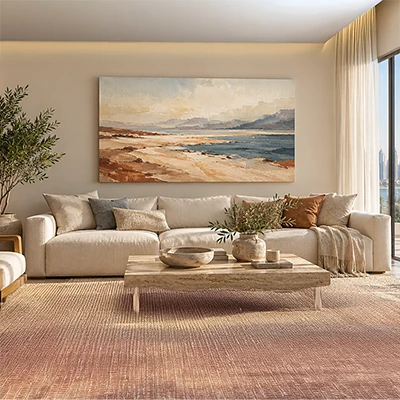
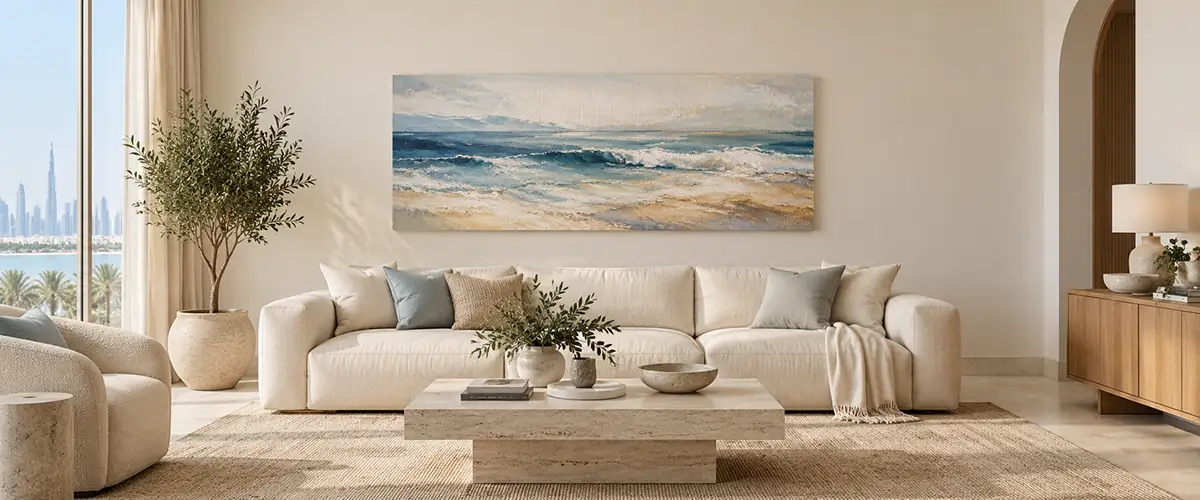
A rough rule that designers use a lot: your canvas (or canvas grouping) should take up somewhere between 60-75% of the available wall space above a sofa, console, or bed. Any smaller and it reads as an afterthought. Any bigger and it starts to feel like it's swallowing the room.
A quick sizing cheat sheet

This isn't gospel — every space is different — but it's a solid starting point for the spaces we print for most often here in the UAE.
- Above a sofa or bed: roughly two-thirds the width of the furniture below it
- Hallways and corridors: narrower, taller formats work better than wide ones — think portrait orientation
- Office reception walls: go big. Corporate spaces almost never regret sizing up
- Small apartments or study nooks: one well-sized piece beats three small scattered ones
And if none of that quite matches your space, that's genuinely fine — this is exactly why we offer free digital previews before anything gets printed. Send us a photo of your wall and we'll tell you honestly what size looks right, not just what sells the most.
Should you go single-panel or split it across multiple panels?

This one comes up constantly, especially with wider walls.
A single large canvas gives you a clean, uninterrupted image. Simple, classic, no fuss. But once a wall gets past a certain width — we're talking villa living rooms, hotel corridors, big open-plan offices — a split canvas (two, three, or even five panels) can actually work better. It creates movement across the wall instead of one static block, and it's a bit more forgiving if your ceiling height is limited.
There's no wrong answer here. It genuinely comes down to the room and your personal taste. Some of our most-ordered pieces are five-panel splits for exactly this reason — they just have more presence in a big open space.
Don't forget about viewing distance
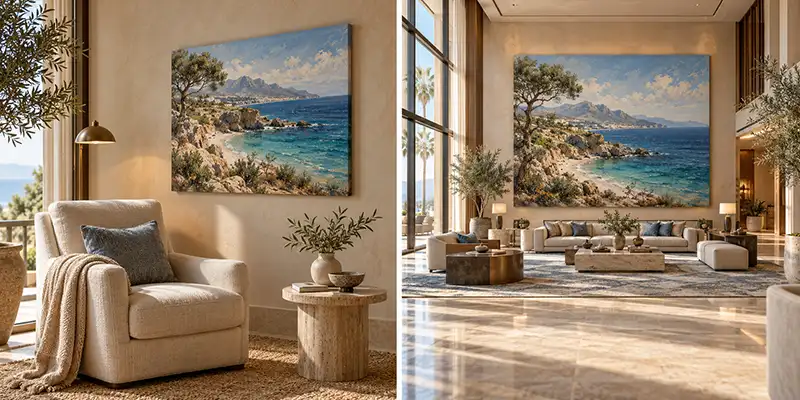
This one gets skipped a lot, and it matters more than people think.
If your canvas is going somewhere people stand close to it — a bedroom wall, a reading nook, a small office — detail matters more, so you can go a bit smaller and still get impact. But if it's going somewhere people view from across a room — a hotel lobby, a large living area, a restaurant dining floor — you actually need to size up more than feels natural, because distance shrinks everything visually.
We've had clients push back on this before ("that seems too big for the space") and then message us a week after installation saying it actually looks perfect once it's up. Distance really does play tricks on you.
What about resolution — will my photo even hold up at a bigger size?
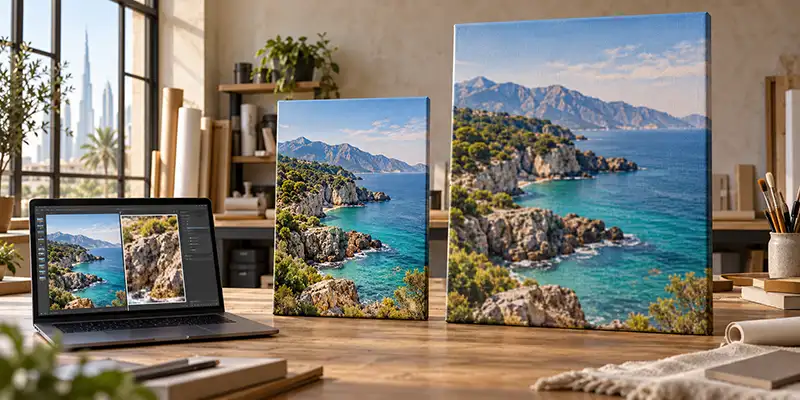
Fair question, and one we always check before printing anything.
Not every photo can be blown up to any size without losing sharpness. It depends on the original resolution of the file. The good news is you don't need to be a photography expert to figure this out — just send us the image before you commit to a size, and we'll tell you straight up whether it'll hold up at 40x60, or whether we'd recommend going smaller (or splitting it across panels to soften the effect). No guesswork, no disappointment after printing.
A quick real-world example
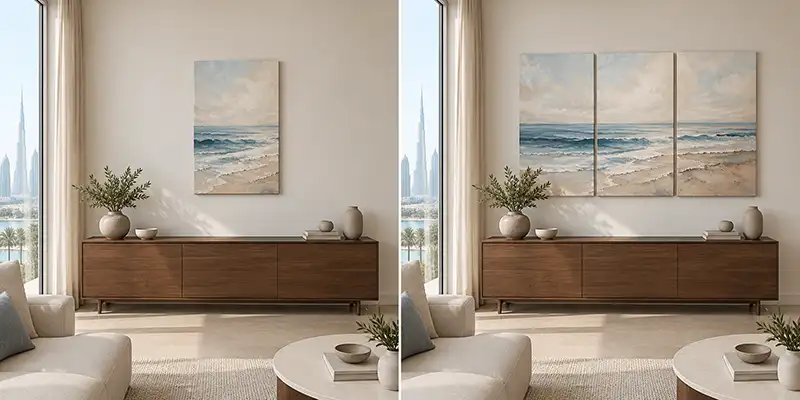
Had a client last year with a fairly standard Dubai apartment living room — around 3 metres of wall space above the console. She was set on a single 24x36 canvas because that's what she'd seen online somewhere.
We looked at the wall photo she sent us and, gently, suggested going bigger — a 40x30 gallery wrap instead, or alternatively a three-panel split to fill the width properly. She went with the split. Sent us a photo once it was up.
It completely changed the room. Genuinely.
That's the thing about sizing — it's rarely about the art itself. It's about the relationship between the art and the space around it.
So, what size should you actually order?

Honestly? There's no single number I can give you without seeing your wall. That's not a cop-out — it's just true. Size depends on furniture, ceiling height, room use, how far people stand, and what other pieces are nearby.
What I can tell you is this: measure first, size the wall (not the photo), and when in doubt, size up slightly rather than down. A canvas that's a touch too small is the single most common regret we hear about. A canvas that's a touch too large? Almost never.
If you want a second opinion before you order, that's what we're here for. Send us a photo of your wall through WhatsApp or our quote form, and we'll give you a straight answer — including our full size guide if you want to browse standard dimensions first.
Frequently Asked Questions
1. What's the most popular canvas size for a living room in Dubai? For a standard sofa wall, most clients land somewhere between 30x40 and 40x60 inches, or a multi-panel split of similar total width. It really depends on your sofa length and ceiling height though — worth checking against your actual wall first.
2. Can I print a small photo at a large canvas size? Sometimes, yes — it depends on the original resolution. Send us the file before ordering and we'll tell you honestly whether it'll hold up at the size you want, or suggest an alternative.
3. Is it better to order one large canvas or split it into multiple panels? Both work well — it comes down to your wall width and personal style. Single panels feel classic and clean; split panels add movement and tend to suit wider walls better.
4. How do I know how big my wall art should be above my sofa or bed? A common guideline is about 60-75% of the furniture's width. Anything smaller can look like an afterthought, anything much larger can overwhelm the space — though every room is a little different.
5. Do you help customers choose the right size before printing? Yes. We offer free digital previews and honest sizing advice before you commit — just send us a photo of your wall and the image you'd like printed.
6. Do bigger canvases cost significantly more? Pricing does scale with size, but it's often more affordable than people expect, especially for rolled or gallery wrap formats. Get a free quote and we'll give you exact pricing for your dimensions.
Not sure what size is right for your wall? Get a free quote or WhatsApp us a photo of your space — we'll tell you straight.